Everything Changes, the Buddhists tell us, so what does it mean to Never Forget?
Only one-third of the people now living in New York City were here on 9/11/2001. People die and move away. Others are born or move here from elsewhere. I remember that day vividly, but perhaps not forever.
I was at home in Park Slope with my one-year-old baby, listening to WNYC as I did every morning. My 9-year-old had gotten the schoolbus and Jim was at work in Dumbo. Our cleaning lady, Vlasta, was with me. She spoke no English and later I would draw a rough sketch of the Twin Towers and a plane.
At some point, the radio went off and then came back on. There was a report of a plane hitting the World Trade Center and I pictured a small private plane gone off-course due to a pilot error. That had happened to JFK Jr two years earlier, though that was at night, and this was one of those impossibly bright and clear September mornings, the sky a nearly fluorescent cerulean blue that the one-third of New Yorkers still here always note as being reminiscent of that day.
The order of the news reports is jumbled in my mind, as it was for the reporters themselves trying to make sense of what was happening, I know now from articles and podcasts. The clear moment for me came when our phone rang, a landline, and a barely recognizable voice, my husband Jim’s, said he’d just seen the south tower fall. I pictured it falling over sideways and knew that an unimaginable number of people would be dead and lower Manhattan destroyed. I wasn’t sure how far such a tall building would fall. The building fell, I now know, at 9:59, so Jim must have phoned about 10:00.
“I’m going to walk to Jacob’s school and get him,” Jim said, “they’ve closed the subways and will close the schools.”
In fact, they didn’t close the schools. They couldn’t because some of the children would have no parent left to pick them up.
At home, waiting for Jim and Jacob, I wonder who did this. American terrorists don’t generally have the stomach for suicide, I think, considering Oklahoma City where babies were killed but not the perpetrators. At some point, Vlasta’s boyfriend comes to pick her up. Sam and I wait. Across the street, where a fireman lives, a member of Squad One in Park Slope which would lose half the men, I see friends streaming in to comfort his wife. I see a woman I think of as Perfect Woman, pushing a cart from the food coop into the apartment–it’s totally against food coop rules to bring a cart so far as 4th Street, a fact which confirms the strangeness of the day.
The mail arrives. I subscribe to the Christian Science Monitor and an article says that two days earlier, the Lion of Pashtun in Afghanistan has been blown up by suicide bombers posing as reporters. I instantly know this is connected. At Columbia, I had taken a course on international politics in the Middle East, taught by Zalmay Khalilzad, who I was madly in love with (as I was with so many professors because I confused the excitement of learning with the magical spell of romantic love), so I had done all the reading and paid close attention. He would later serve at the state department and was, on 9/11, in the Situation Room.
I call Jacob’s school, where I often volunteer and will take a job the following year. I speak to a teacher and ask if Jim is there. She says he is, that he is helping. I ask her if they will close the school and she says they can’t, because they don’t know which kids won’t be picked up. I ask her to tell Jim to please come home now.
Jim and Jacob walk home, the mile or so from Carroll Gardens across the Gowanus Canal. A friend later tells me that she and her son waited at a car service for a ride and all through the long wait the television was on, showing over and over people jumping from the towers. Which now I realize is something that is hard to find in any of the reporting. That day it seemed all there was, and I was thankful we didn’t have a tv.
When Jim and Jacob get home, we go outside. Burnt bits of paper rain down on us like snow, though we are five miles from the towers. We walk along the avenue. We buy a few things at the food coop. We go to the meadow in Prospect Park. Everyone is out on the streets, walking in a daze, hugging and greeting each other, reporting what they know, what they’ve heard, who they know who worked in that area or in the towers, whether they’ve heard from them. We bring home a piece of burnt paper, almost whole, just the edges singed, from an insurance company publication.
Soon we learn that the firefighter across the street is unlikely to come home. The next morning, early, I see his wife and another woman, dressed for work (did we really go to work on 9/12?) going into the landlady’s apartment with a pan of lasagna. The widow’s freezer was already full.
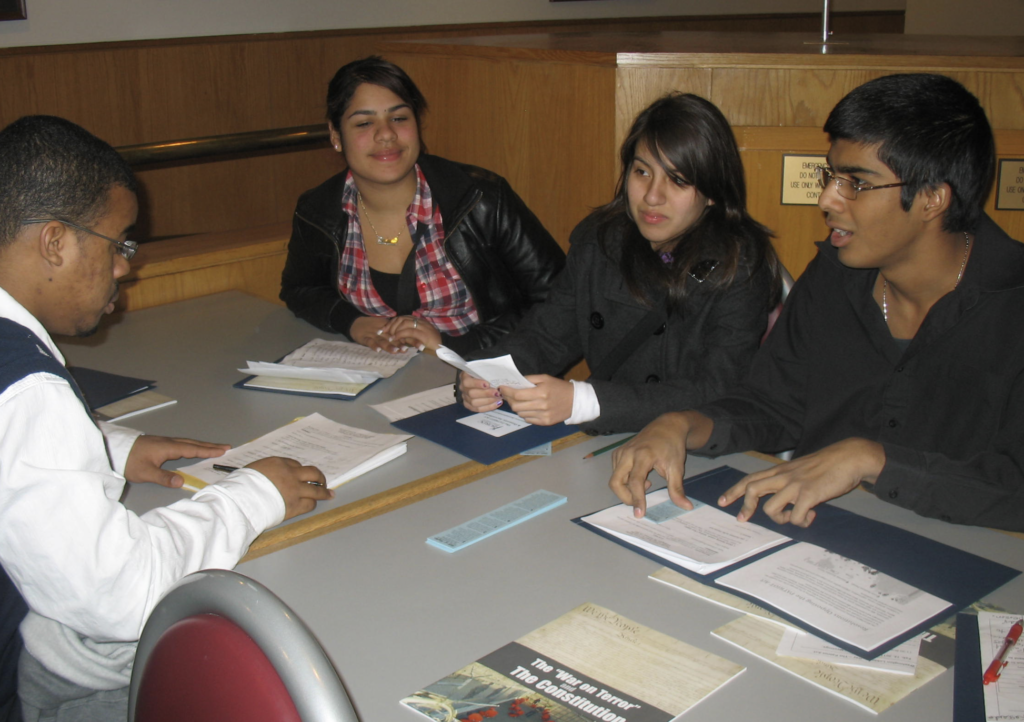
Ten years later, I would teach a government class on the Bill of Rights. We studied 9/11 and the Patriot Act, trying to answer the essential question of the course, “How do we balance freedom and safety?”
At that time, there was a museum, Newseum, “dedicated to news, journalism, and the five freedoms protected by the First Amendment to the United States Constitution.” It no longer exists. I was able to download and print the front pages on 9/12/2001 from newspapers all over the country, so that my students who had been only seven years old at the time, could consider what we knew and when we knew it. We have lost so much journalism since then, in these 25 years. A loss that is different from merely change, the churning of population of New York City, which is part of nature. The loss of daily journalism, on the ground, is not natural.
Of those students, many were Arab or Southeast Asian and they all had relatives taken in for questioning in the days after 9/11. We learned about the Bill of Rights and the laws and probable cause. We went to Washington DC and lobbied in the days before the reissue of the Patriot Act in 2011. My students held a range of positions, debating each other, and communicated them well. A staffer in Senator Schumer’s office said, “they know more about the Bill of Rights than I do.”
In 2020, just before everything closed down, I heard a neuropsychologist speaking about memory and grief and whether time heals. She said “we know that engaging with a memory changes it. Each time we pull it up, or hear other people tell it to us, it’s different when we store it again. That’s why sometimes people end up not sure if they themselves remembered something or it was told to them by someone else. Memories are not permanent. We can see this in the brain.”
We tend to think of memory as functioning something like a videotape: capturing what happened and replaying it with fidelity. New research suggests that memories are stored as compressed representations: we hold onto perhaps two dots of a larger picture. When we retrieve that memory, we pull up those two dots, which we then expand by generating all the interconnecting elements, like a digitized approximation rather than an exact replica. Hippocampal ripples and cortical dimensionality expansion is what the researchers call these processes. From those two dots, bits of imagery, we elaborate history into a 3D landscape. Is it frozen in time at the moment, trustworthy in the original capture of those two facts? Or does it change, based on who we are now and what we know when we retrieve that memory?
I want to try to actually remember, to not use “never forget” as some kind of identity tagline, brayed by people who were far away, but to actually truly remember the fear and courage and horror of that day. People went to hospitals to donate blood, emergency rooms were fully staffed in anticipation of injuries, but they would end up empty. Posters of missing persons were all over the city, and there was hope that some people were in a hospital somewhere, in a coma or having lost their memory. We would end up getting our news from the little Portraits of Grief in the New York Times, and it was there I learned that the partner of the woman who owned the shoe store on my corner had never come home. And where I would see my student Max, who had talked all summer about how special his dad was, how he was a chef at the restaurant on the top of the World Trade Center, listed, along with his mother and little brother, as survivors of one of the men in one of the many portraits of grief.